
Mini Rose French Macarons
These Mini Rose French Macarons are a gorgeous addition to your tea party or tea party themed birthday, including Alice in Wonderland and Mad Hatter's Tea Party. These are both nut free and gluten free.
Servings 24 cookies (approx.)
Equipment
- #101s petal piping tip
- disposable piping bags
- Plastic tip coupler
- piping bag holders or a tall drinking glass
- metal flower nail
- Waxed paper cut into 1.5- or 2-inch squares
- food grade paintbrush optional
- 2 macarons mats
- 2 half sheet pans
- large sized round tip like 2A
- plastic cake tweezers optional
- large star tip, such as 6B
- #65 piping tip optional, for small leaves
Ingredients
For the Mini Roses:
- Easy Vanilla Buttercream or Vanilla Swiss Meringue Buttercream see note
- pink food coloring gel such as AmeriColor or ChefMaster
- gold or iridescent luster dust optional
For the Macaron Shells:
- 126 grams oat flour
- 126 grams powdered sugar
- 100 grams egg whites see note
- ¼ teaspoon cream of tartar
- 90 grams granulated sugar
- 1 teaspoon vanilla extract see note
- green food coloring gel
- iridescent luster dust optional
For Assembly:
- Easy Vanilla Buttercream or Vanilla Swiss Meringue Buttercream see note
Instructions
Pipe the Mini Buttercream Roses:
- Fit a #101s small petal piping tip into a disposable piping bag with a plastic tip coupler.

- Tint some buttercream shades of pink and carefully stir with the untinted buttercream, then transfer to the piping bag. For a more variegated pattern, paint the inside of the piping bag with pink food coloring gel only on the side of either the wide or narrow end of the piping tip, depending on whether you want the pink more toward the base or top of the roses. Then, fill the bag with untinted buttercream to the bag.
- Pipe a small dot of buttercream on a metal flower nail.

- Place a square of waxed paper on top and press down to adhere.

- Pipe a small mound of buttercream. Holding the petal tip with the larger opening at the bottom, pipe around the mound to create a bud.

- Still holding the larger opening of the piping tip down, pipe 3 - 5 overlapping petals around the bud. You will use an upside-down U motion to create the petals. Most of mine had a single row of 3 or 4 petals around the bud. For a slightly larger rose, you can do the bud, then 3 overlapping petals, then an outer layer of 5 overlapping petals.

- Carefully remove the waxed paper from the flower nail and place it on a baking sheet. Repeat to make many more roses.

- Chill the roses in the refrigerator or freezer to set them. If desired, brush them with gold or iridescent luster dust using a food grade paint brush.

Make the Macaron Batter:
- Place a macaron mat on each of 2 baking sheets. You can also use parchment paper with 1-inch circles drawn on underneath. Set these aside.
- Place a large round tip, like a #12, in a disposable piping bag. Twist the bag above the piping tip and clip it closed with a small binder clip. Fold over the top of the bag and place it in a tall glass or in a piping bag holder so it will be easy to fill with the batter. Set aside.
- Sift together the oat flour and the powdered sugar in a medium-sized bowl, then whisk to combine them completely. Set this bowl aside.
- Place the egg whites in the bowl of a stand mixer fitted with the whisk attachment and beat on medium-high until frothy.
- Add the cream of tartar, then slowly add the granulated sugar, one spoonful at a time, with the mixer still running.
- Add the vanilla extract and a small amount of green food coloring gel, or any color you prefer. Keep in mind that the color of the batter will deepen slightly after the dry ingredients are incorporated. Continue to beat the mixture until the meringue forms stiff peaks. Remove the bowl from the mixer.
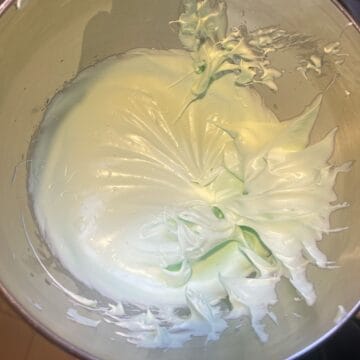
- Using a large silicone spatula, carefully fold ⅓ of the flour/powdered sugar mixture into the meringue. Then add the remaining ⅔ of the flour mixture and continue folding until you reach the figure 8 stage. See note.
- Transfer the batter to the prepared piping bag.

- Twist the top of the bag closed and remove the clip to allow the batter to flow into the tip. Pipe 1-inch circles of batter onto a macaron mat, then slam the tray down on the counter to force bubbles to the top. Use a toothpick to pop any bubbles on the surface. Then, pipe the rest of the batter on the second tray and repeat the process of removing bubbles. You will not fill the second tray.
- Allow the batter to dry at room temperature for about 40 minutes, until the batter has formed a "skin" and no longer sticks to your finger when touched lightly. The temperature and humidity of the work space will affect required drying time. Meanwhile, preheat the oven to 300°F.

- Bake the macaron shells for 12-15 minutes, rotating the pan once about 7 minutes into the bake. Only bake one pan at at time. Do not overbake or shells will be crispy.
- Allow the shells to cool completely on the mats before removing them. To remove more easily, push up on the mat from underneath to help them pop off. If you have trouble with them sticking, that may mean they are underbaked. Some of the shells in the center of the tray may have a little bit of sticking. Very carefully use a stiff metal spatula to pry them off the mat, taking care not to rip the shell.
- After the shells have completely cooled, use a food grade paint brush to apply dry luster dust, if desired.

- Cooled shells can be assembled into cookies immediately or stored in the refrigerator or freezer. Store in an airtight container in single layers, with parchment paper separating the layers to prevent sticking.
- Before assembling, pair up the macaron shells by size to most closely match the top and bottom shell.

Macarons with Rose Perimeter:
- Pipe a mound of buttercream using a piping bag fitted with a large round tip, such as a 2A.

- Use plastic cake tweezers or gloved hands to carefully transfer a chilled mini rose to the buttercream, facing out.

- Repeat until the entire perimeter of the macaron shell is filled with mini roses. If you have some lighter and darker roses, you can alternate them to create a pattern. Depending on the size of the macaron shells and the roses, it can take up to 14 roses per cookie.

- Carefully place the top shell on top and press down just enough for it to stick and not have gaps above or below the roses.

- If desired, add small leaves in the spaces between the roses using light green buttercream and a #65 small leaf tip.
Macarons with Single Rose on Top:
- Fill a piping bag fitted with a large star tip, like a #6B, with pink and white buttercream. For a more dramatic ombre effect, fill one side of the bag with pink and one side with untinted buttercream.

- Pipe a mound of buttercream on the bottom shell.

- Lift the top shell by the edges and place it on top of the buttercream, twisting slightly as you press down. Repeat with the remaining pairs until all of the macarons have been filled.
- Pipe a small dot of buttercream in the center of each top shell and place a single mini buttercream rose on top. Then, use a #65 small leaf tip to pipe two pale green buttercream leaves per rose. You can also do a small grouping of 3 roses on top of each macaron and add more leaves.

Notes
Easy Vanilla Buttercream recipe HERE, Vanilla Swiss Meringue Buttercream recipe HERE
I highly recommend weighing the ingredients listed in grams. French macarons are notoriously finicky and require precise measurements.
I recommend using cracked whole eggs, not store bought egg whites. 100 grams of egg whites is the equivalent of the whites from about 3⅓ large eggs.
Clear vanilla extract can be used in place of traditional vanilla extract if you want a lighter batter that is easier to tint with food coloring. You could also use a different flavor of extract if you prefer, such as almond extract or imitation almond extract to keep the macarons nut free.
Macaronage: The process of incorporating the dry ingredients into the meringue is called macaronage. I recommend reading about this at America's Test Kitchen to familiarize yourself with how the batter should look. This step is critical for the shells forming "feet" properly. You want the batter to flow off the spatula like a ribbon, and when you draw a figure 8 with the batter that flows off, you want it to slowly go back into the batter still in the bowl but not too quickly.
Storage: Store the assembled cookies in an airtight container in the refrigerator for up to several days or frozen for 3-6 months. If refrigerated or frozen, allow the cookies to reach room temperature before serving.
Nutritional information is only an estimate and will vary based on your ingredients and substitutions.
You're Gonna Bake It After All
bakeitafterall.com